
Criminal Court Cases in Fentress County
Fentress County criminal court cases divide between two trial levels. Criminal Court hears felony prosecutions in Tennessee's Eighth Judicial District. General Sessions Court hears misdemeanors within its jurisdiction and conducts early proceedings in felony matters. One prosecution can therefore begin in General Sessions and later move to Criminal Court. The Tennessee courts description of General Sessions jurisdiction helps explain that split, but the local case file remains with the Fentress Circuit Court Clerk.
The clerk maintains Circuit, Criminal, General Sessions, and Juvenile Court records. Jamestown City Court has a separate municipal channel for ordinance matters, while the County Clerk and the Clerk and Master are not the criminal docket custodians. Ask which court owns the docket before ordering a copy. That one detail prevents a name search from landing at the wrong office.
Fentress also sits within the five-county Eighth Judicial District. The district attorney presents prosecutions, but that office is not the public docket custodian. Filed pleadings and court orders still come from the clerk. The official District Eight profile helps identify the prosecution office when victim services or case-party contact is needed, while the clerk remains the source for court copies.
Fentress Court Records at Suite 126
The working counter for Fentress County court case records is the Circuit Court Clerk in Suite 126 of the Fentress County Justice Center. The office is at 140 Justice Center Drive, Jamestown, Tennessee 38556. Call 931-879-7919 or fax 931-879-3014. The official Circuit Court Clerk page identifies the courts and contact block.
Fentress Circuit Court Clerk
140 Justice Center Drive, Suite 126
Jamestown, TN 38556
931-879-7919
Fax: 931-879-3014
A request may ask for the docket sheet alone or for the charging instrument, judgment, sentence, and public orders. Confirm copy cost, certification charge, remote payment, archive coverage, and delivery method with the clerk because official sources reviewed did not publish those local terms.
The county clerk source also provides a visual reference for the correct office.
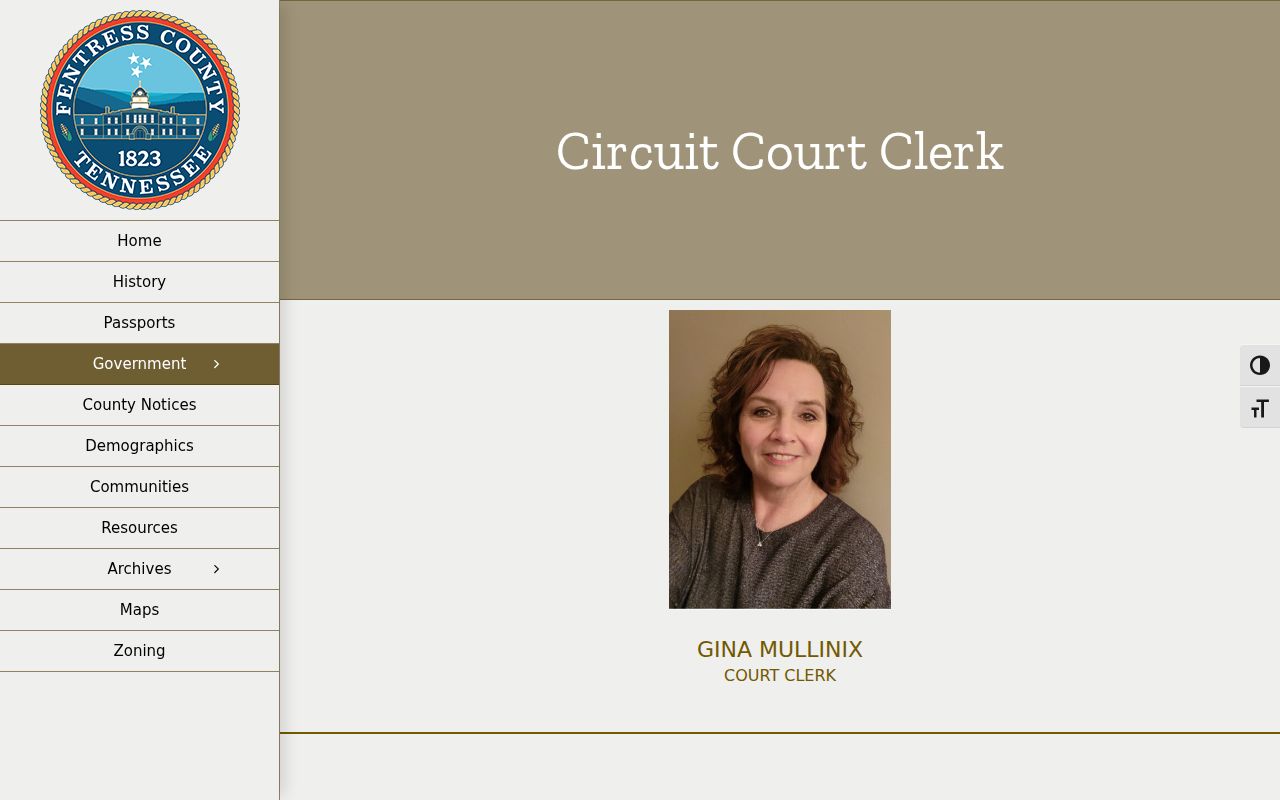
That office, rather than a statewide trial portal, is the source for local docket copies and certified dispositions.
Fentress County Case Record Searches
No official source reviewed exposed an online Fentress trial-docket search. A sound court case lookup starts with the clerk and a narrow description. Use the full name, the court if known, an approximate filing year, and the docket number when available. Ask staff to distinguish General Sessions from Criminal Court.
- Call or visit the Circuit Court Clerk and name the likely court.
- Give the defendant's full name and approximate case year.
- Add the docket number or charge when known.
- Request the docket sheet, then identify the needed filed documents.
- Confirm cost, certification, payment, and delivery before ordering.
| Field Label | Type | Required | Notes |
|---|---|---|---|
| Full name | Text | Yes | Use the complete legal name when possible |
| Docket number | Text | No | Best way to identify one file |
| Court | Choice | No | Criminal Court or General Sessions |
| Approximate year | Year | No | Narrows a common-name search |
| Requested document | Text | Yes | Docket, charge, judgment, sentence, or order |
For a public-record request under the Tennessee Public Records Act, describe an existing record rather than asking the office to create a new summary. Tennessee court resources also publish a request-to-access-court-records form.
Fentress Charges Move Between Courts
A felony matter may appear first in General Sessions for its preliminary stage, then continue in Criminal Court. That does not mean two unrelated prosecutions exist. The court name, case number, filing date, and linked charging papers show the path. Misdemeanors can remain within General Sessions jurisdiction, while felonies belong in Criminal Court for trial-level prosecution.
The arrest allegation may also differ from the charge a prosecutor files. Officers record the basis for arrest. The district attorney decides what charges to present or pursue, and the court records the result. For Fentress County criminal court cases, the filed charging instrument and final judgment carry more weight than the intake charge on a booking sheet.
The General Sessions source illustrates this lower-court role.
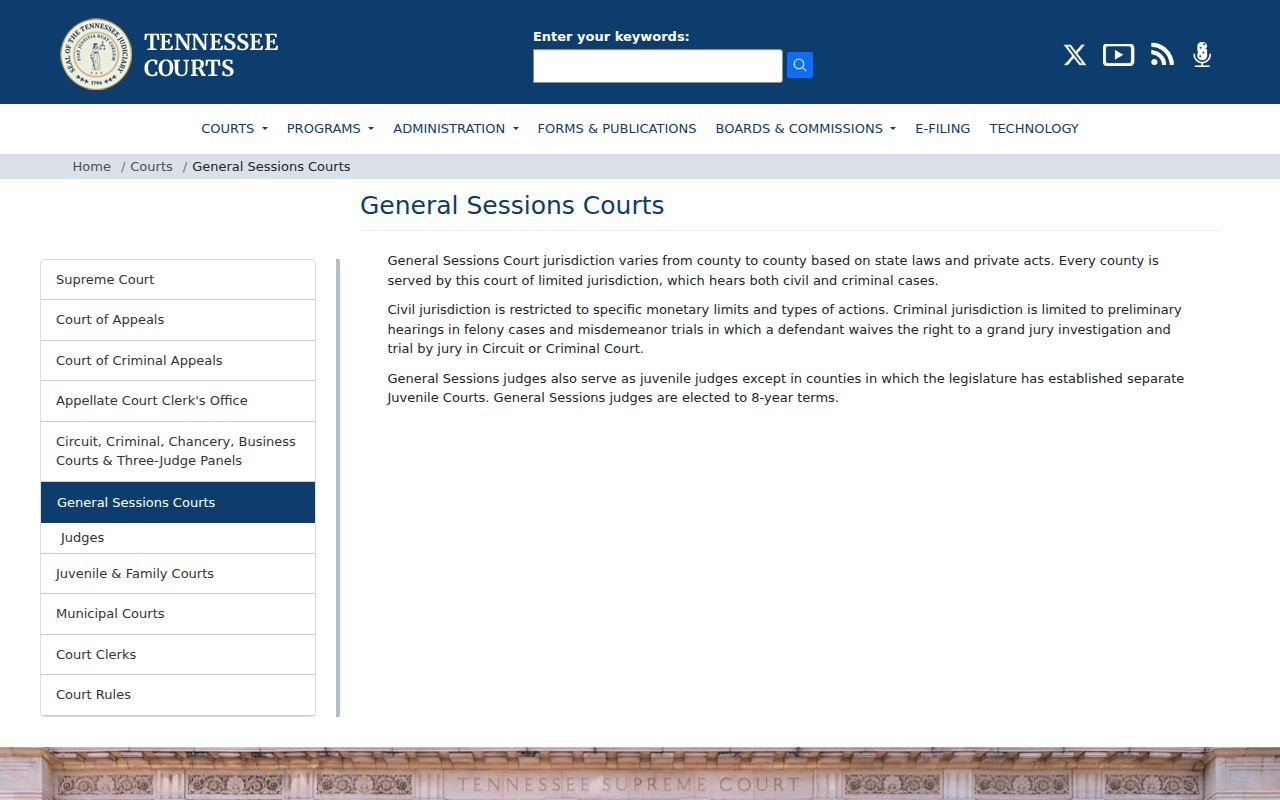
Reading the local docket in sequence shows when the matter advanced and which court now holds the active file.
What a Criminal Case File Contains
A Fentress County court case file is richer about procedure than an arrest report. It can identify the court, judge, case status, filed counts, attorneys, event dates, pleas, orders, judgment, and sentence. Public bond entries and financial obligations may also appear. Request the actual judgment when the outcome matters because a docket label alone may not show every term.
| Case Number & Court | Identifies the docket and whether General Sessions or Criminal Court handled it |
|---|---|
| Charging Document | Shows the filed counts, offense descriptions, and Tennessee code citations |
| Docket Entries | Lists motions, hearings, orders, and other recorded case events |
| Hearing Dates | Places arraignment, pretrial events, plea, or trial in sequence |
| Disposition & Judgment | Records dismissal, plea, verdict, conviction, or another final result |
| Sentence & Conditions | May state incarceration, probation, fines, costs, restitution, and credit |
Certification status matters when the copy will be used to correct a separate government record. A plain copy is useful for reading; a certified disposition carries the clerk's authentication.
Fentress Dispositions Can Correct TORIS
Tennessee Open Records Information Services organizes criminal history around fingerprint-linked arrest cycles and reported outcomes. A missing disposition can leave a statewide result incomplete. First obtain the Fentress docket and a certified disposition for the disputed court result. Then follow the Tennessee Bureau of Investigation challenge process with the authoritative court document.
The clerk can correct its own docket, but it cannot directly rewrite each downstream database. TBI can reconcile repository information after it receives proof from the court. This process corrects an error; it does not expunge an accurate record. A legally eligible record must follow the expungement route through the court that owned the case.
Note: Match the docket number, arrest cycle, charge, and disposition before asking either office to change a record.
Criminal Case Stages in Fentress County
The court file begins with charges as filed, not merely with the arresting officer's allegation. An arraignment places the filed accusation before the defendant. Pretrial entries can include motions, bond orders, hearings, and scheduling. A plea or trial leads to a disposition. If guilt is established, the judgment and sentence record the court's action. Local official sources did not publish fixed completion times, so a docket should be read by dated events rather than an assumed schedule.
Case flow: Charges Filed › Arraignment › Pretrial › Plea or Trial › Disposition › Sentencing
Later motions, revocation proceedings, or an appeal can add entries. The active case status and newest order help show whether the first judgment still controls.
Read Fentress Felony Case Labels
Tennessee uses Class A through Class E labels for felonies. Those labels describe statutory ranges, not the sentence imposed in one Fentress County court case. A misdemeanor can be labeled Class A, B, or C. The offense statute, offender range, enhancements, credits, alternatives, and case-specific judgment all affect the actual result.
- Charge
- The offense formally alleged in the filed court papers.
- Disposition
- The recorded outcome for a count, such as dismissal, plea, or verdict.
- Judgment
- The court's formal entry of the result and sentence.
- Capias
- Court process that may direct an arrest or appearance.
When a docket abbreviates a grade or outcome, request the charging document and judgment. Those records identify the code citation and final action more clearly than a short docket label.
Fentress Appeals and Federal Dockets
The Tennessee Appellate Court Public Case History covers the state Supreme Court, Court of Appeals, and Court of Criminal Appeals. It can show case number, style, status, filing dates, originating court, judges, event history, and some document links. It is not a search for Fentress trial dockets. Use it only after a matter reaches the appellate level.
Federal cases take a different path. Fentress County lies in the Northeastern Division of the U.S. District Court for the Middle District of Tennessee. Federal docket entries and filed documents are searched through PACER, not Suite 126. The division page supplies the courthouse and filing arrangement.
The official federal division source shows that separate route.
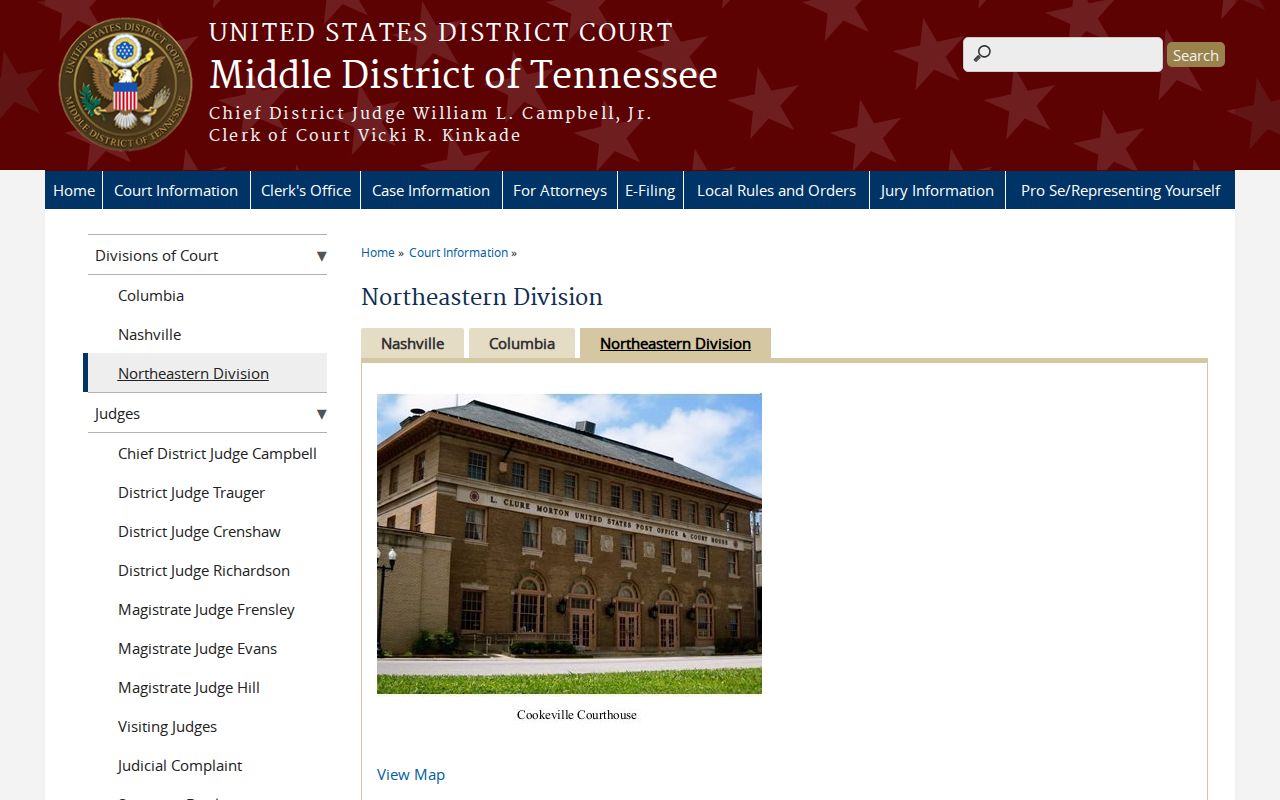
The practical rule is simple: local clerk for county trials, PCH for Tennessee appeals, and PACER for federal cases.
Access Rules for Case Records
The Tennessee Public Records Act guidance explains the general citizen inspection framework, but court access is still record-specific. Tenn. Code Ann. sections 10-7-501 through 10-7-515 govern public records broadly. Judicial rules and sealing orders also control court files. Juvenile material, sealed or expunged cases, protected victim information, and sensitive filings can be withheld or redacted.
Section 40-38-111 protects specified crime-victim identifying information. Section 40-32-101 governs expungement. If only part of a record is protected, ask whether the clerk can provide the segregable public portion. A court case lookup should never be used to guess what a sealed file contains.
For broader arrest and booking context, the Fentress County arrest search explains why the sheriff's custody record and the filed court case may show different charge wording.
When staff cannot promptly produce a public record, ask what identifier is missing, whether the file is archived, and whether a written request would help. Do not assume that a delay signals a sealed case. It may reflect a common name, the wrong court level, an older file, or a request that does not name a specific existing document.